


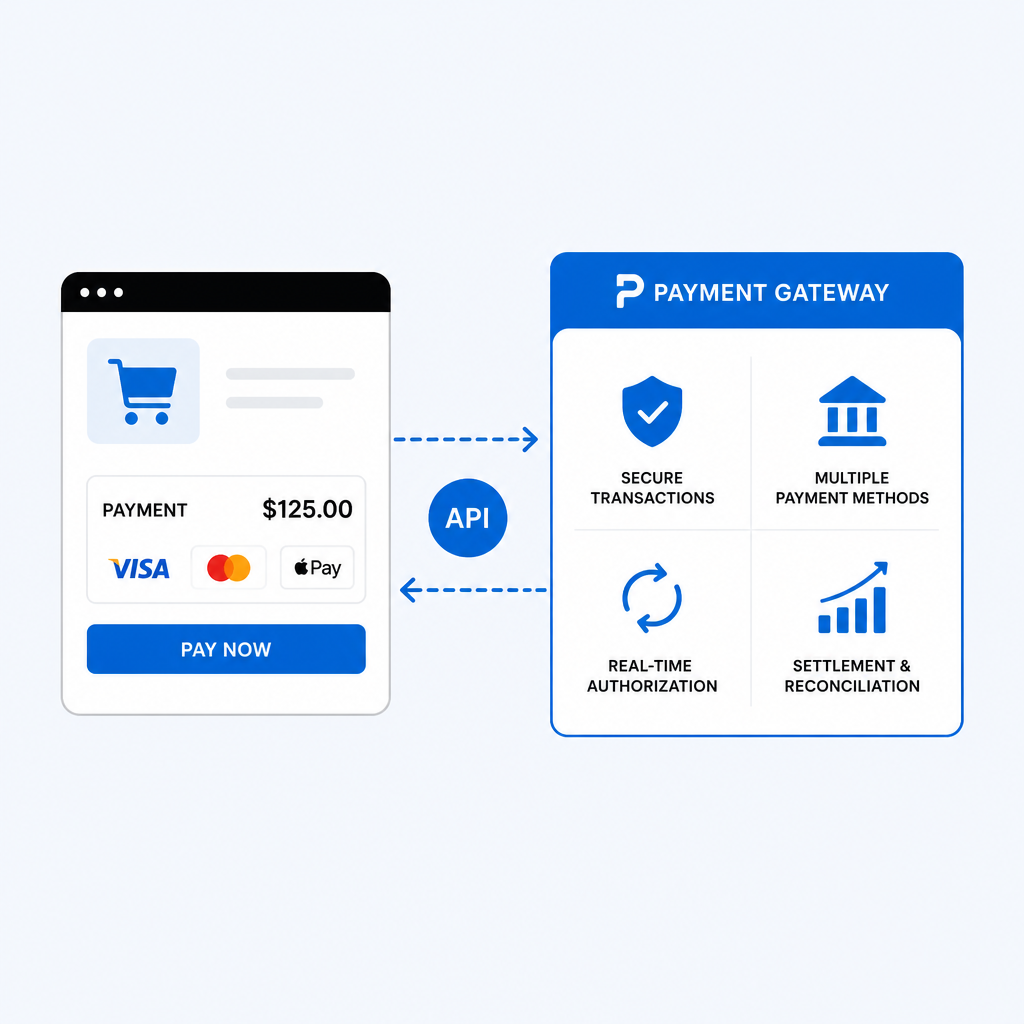
A failed bank connector rarely stays an engineering issue. It turns into delayed merchant onboarding, emergency routing changes, support tickets, and an acceptance rate discussion you did not want on the calendar. For a PSP CTO, a payment gateway API has to do more than move authorization requests. It has to give you controlled transaction processing, reporting, security, and integration patterns that keep payment operations stable as you add acquirers and payment methods, then update risk rules.
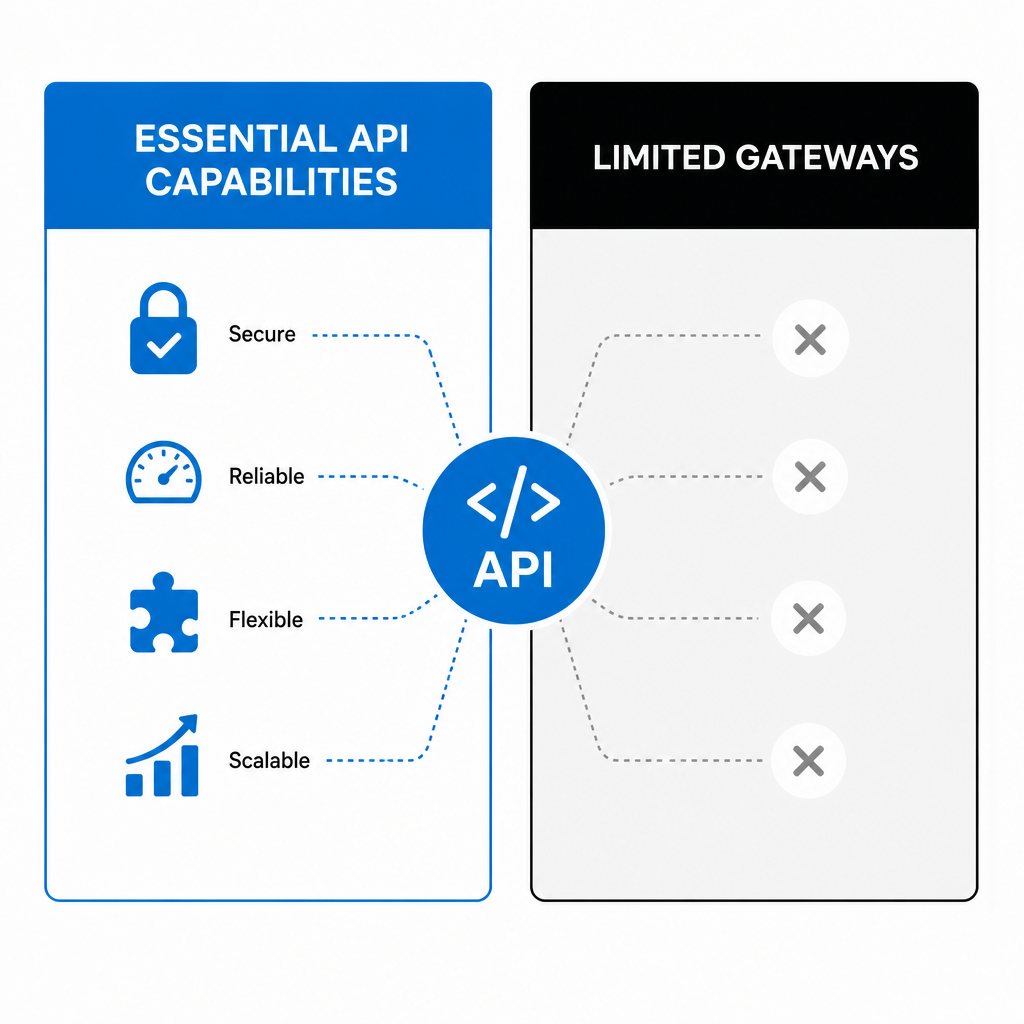
The essential API capabilities your payment gateway needs: the short answer
Verdict: choose the API model that gives you control over the transaction lifecycle, acquiring options, routing, merchant configuration, security controls, and operational reporting without forcing your team to rebuild the gateway each time the business adds a provider.
A payment gateway API is the operating layer between your merchants, upstream providers, risk systems, and back office. It decides how quickly you can launch merchants, change processing paths, diagnose failures, and keep payment processing stable under load. If that layer is too narrow, every commercial change becomes an engineering project. If it is too opaque, you lose the routing and data control that PSPs need.
Core transaction processing
Transaction processing has to cover the full lifecycle, not authorization alone. Your API needs to support authorizations, captures, voids, refunds, status checks, callbacks, reconciliation data, and the operational states between them. If the API cannot express the real transaction states your merchants and acquiring partners use, your team ends up building translation logic around it. That logic spreads into merchant adapters, back-office tools, support scripts, and risk systems, which makes every change slower and harder to test.
A capable API should also manage request flow and authorization boundaries cleanly. The IMF described an API gateway as the layer that handles external requests and authorizations, which matters in payment and settlement systems because a bad request or duplicate call, as well as unclear state, can become money movement risk.
Security and compliance
Security belongs in the API design, not buried in documentation after the fact. The API should support strong authentication, controlled access by merchant and role, secure handling of sensitive data, auditability, rate controls, and predictable error behavior. For PSPs, the goal is practical control: you need to keep sensitive transaction data and operational permissions out of places where they are hard to govern.
The right gateway layer gives you a defined security and control point for the services behind it. CNCF described an API gateway as a layer of security and control that helps protect data and keep APIs highly available. In payment infrastructure, that means fewer uncontrolled entry points and cleaner ownership. It also gives incident response a clearer path.
Integration and flexibility
Integration is where the architecture either gives you operating room or takes it away. The API should let you add acquirers, payment methods, routing rules, merchant settings, and reporting outputs without rewriting the merchant-facing integration. That matters because payment methods keep multiplying. Mastercard describes digital wallets, biometrics, and tokenization as part of the shift in payment acceptance, with tokenization enhancing security and approval rates, and digital wallets overtaking physical cards while biometrics are replacing passwords. A gateway API that cannot absorb that variety becomes a bottleneck for merchant onboarding and acceptance rate work.
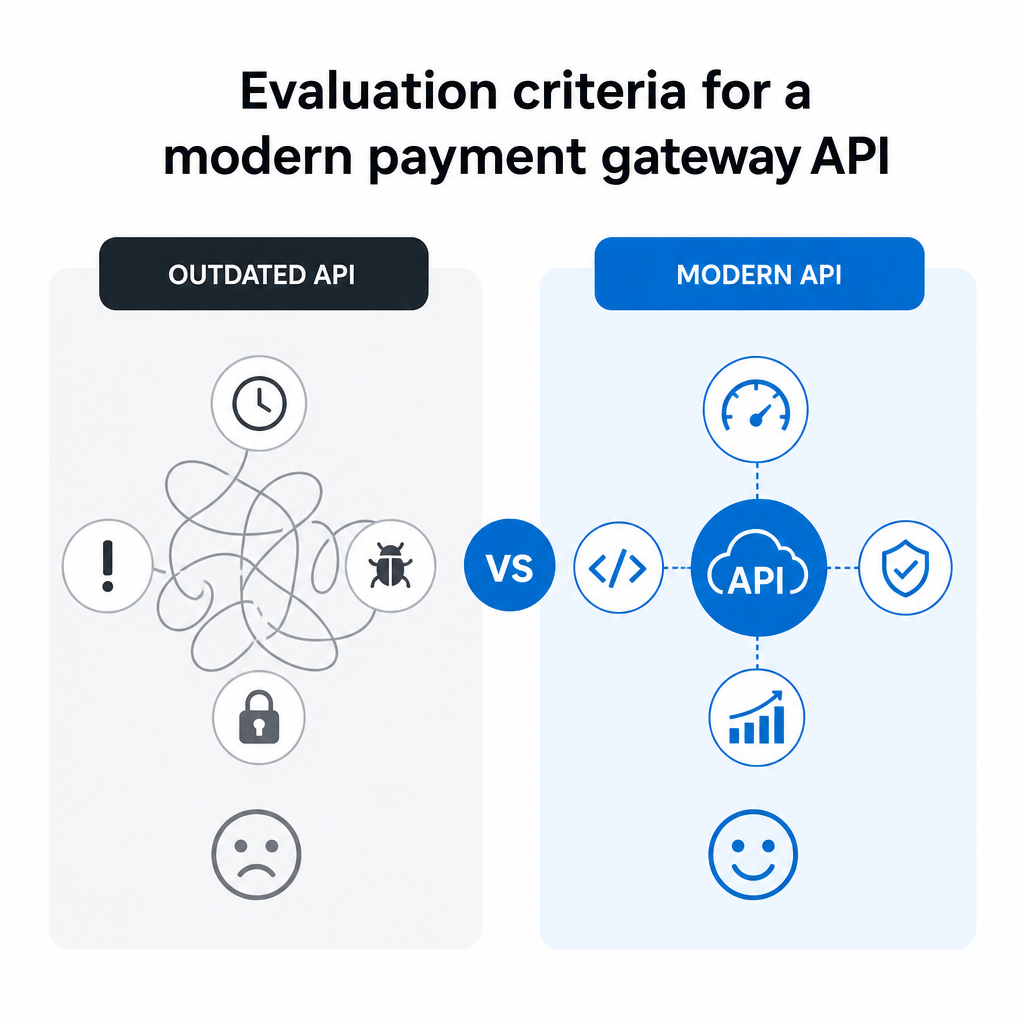
Evaluation criteria for a modern payment gateway API
Now that the essentials are clear, the next step is to break down the specific criteria for evaluating a gateway API. Vendor checklists tend to overemphasize the number of endpoints. Your real concern is whether the API reduces engineering time while preserving control over payment infrastructure.
Transaction lifecycle management
Start with lifecycle coverage. The API should make each transaction state visible, queryable, and actionable. If a payment is pending, partially captured, reversed, disputed, retried, or routed to another provider, your systems need to know that without relying on manual reconciliation or support intervention. Reporting is part of this criterion because transaction data is only useful if finance, risk, support, and merchant operations can trust it.
Acquirer and payment method extensibility
The next criterion is extensibility across acquiring options and payment methods. Mastercard notes that alternative rails such as PIX, UPI, and mobile wallets can expand merchant coverage, speed settlement, reduce fees, and lower chargebacks. The exact commercial impact depends on your markets and merchant mix, but the API implication is clear: a PSP cannot afford a gateway model where every new rail requires a new merchant integration.
Security and data portability
Security, risk controls, and data portability should be evaluated together. AI is becoming embedded in authorization and fraud prevention, allowing for adaptive risk scoring and predictive blocking in milliseconds, according to Mastercard. That means your API should give risk systems clean access to transaction context while keeping sensitive data controlled. You also need portability because PSPs change acquirers, add banks, split processing by merchant segment, and adjust routing. If transaction data is trapped in one provider's operating model, your commercial flexibility narrows.
Comparing gateway API approaches
With those criteria in place, the common architectural choices become easier to compare. The scores below reflect the trade-offs a PSP CTO usually faces, not a claim that every provider in a category behaves the same way.
| API approach | Transaction lifecycle control | Acquirer and payment method flexibility | Security and data control | Reporting and operations | Engineering burden |
|---|---|---|---|---|---|
| Basic acquirer API | Medium | Low | Medium | Low to medium | High over time |
| All-in-one payment platform | Medium | Medium | Low to medium | Medium | Low at first |
| White-label gateway API | High | High | High | High | Medium, then lower |
Read the table as a map of where effort accumulates rather than a ranking. A basic acquirer API is cheap to start and expensive to extend, because each new provider adds another connector, another settlement format, and another set of exception paths your team owns. An all-in-one payment platform moves that work to the provider, but it also moves routing, merchant configuration, and data availability decisions with it. A white-label gateway API sits between the two: a ready payment core, with the routing, reporting, and provider strategy still under your control.
The decision is really about where complexity lives. You can keep it inside your own team, accept the rules of a bundled provider, or use a white-label payment gateway designed to absorb payment complexity while leaving you in control of the operating model.
Assessing basic acquirer APIs
The most direct option is also often the most rigid. Building directly on a single acquiring bank's API can make sense when your PSP has one market and one main acquiring relationship, with a narrow merchant profile. The first build is easy to understand because it has fewer parties and routing decisions, plus fewer abstractions between merchant requests and authorization responses.
The strain appears when the business grows. A second acquirer means another connector, settlement format, callback model, set of failure cases, and often another set of merchant-level rules. If your merchant-facing API was built around the first acquirer's assumptions, your team has to hide the differences inside adapters. That can work for a while, until routing, retries, fraud rules, refunds, and reporting all need to behave consistently across providers.
This approach also tends to make incidents harder to contain. If one provider has degraded performance, the PSP needs routing options that can change without touching merchant integrations. With a single-acquirer API model, provider logic often sits too close to the merchant integration layer. The result is brittle payment infrastructure: the business wants more acquiring options, while engineering is protecting old assumptions.
There is an operational cost as well. Reconciliation, chargeback handling, and merchant reporting all inherit the acquirer's data model, so finance and support teams learn one provider's vocabulary instead of your own. When a second provider arrives, those teams work from two sets of statements and two definitions of the same transaction state, and the reconciliation gap usually surfaces at month end rather than in testing.
A basic acquirer API is acceptable for a narrow start. For an established PSP with active merchants and a roadmap for more banks, fintech companies, marketplaces, or large merchants, it usually turns into maintenance drag.
Assessing all-in-one payment platforms
To get away from the limits of single-acquirer APIs, many PSPs look at fully bundled solutions. These platforms can reduce setup work because the provider owns much of the processing stack and operational tooling, including the merchant configuration model. For a PSP under pressure to launch quickly, that can look attractive, especially if the immediate goal is to reduce connector work.
The trade-off is control. A PSP is not a regular merchant. You need to manage merchant onboarding, risk profiles, acquiring options, routing decisions, reporting outputs, and operational workflows as part of your own business. If the platform's rules define merchant structure, routing behavior, data availability, and exception handling, your PSP starts adapting its operating model to the platform instead of shaping payment infrastructure around its own requirements.
This becomes more visible as payment acceptance diversifies. Mastercard describes gateways moving toward unified payment experience platforms that combine cards, bank rails, wallets, and biometrics into one flow. A bundled platform may support many payment experiences, but the PSP CTO still has to ask who controls the abstraction. If you cannot adjust routing logic while preserving merchant-facing consistency and keeping transaction data portable, convenience becomes dependency.
Exit cost is the other thing to price in early. Bundled platforms hold merchant configuration, tokenized credentials, and historical transaction data inside their own model, so a later migration is a commercial negotiation as much as an engineering project. Before committing, confirm how merchant records, tokens, and settlement history can be exported, and whether routing rules can be reproduced outside the platform.
All-in-one platforms can fit smaller programs that prefer provider-managed operations. For a PSP that wants to own its acquiring strategy, they can be too restrictive.
Assessing white-label gateway APIs
For PSPs that need control and scale, a white-label approach gives you a third path. You avoid a full in-house gateway build, but you also avoid a bundled platform that forces your operating model into someone else's structure. A white-label payment gateway gives your PSP a ready payment core while keeping your brand, merchant relationships, routing approach, and provider strategy under your control.
This model is strongest when the API separates merchant-facing integration from provider-facing complexity. Your merchants should not need a new integration because you added a bank, changed routing rules, or introduced another payment method. Internally, your team should be able to manage provider configuration, transaction state, reporting, retries, and risk-related controls from a consistent gateway layer. That is how you reduce engineering time without giving up ownership of payment infrastructure.
Payneteasy fits this model for PSPs, banks and financial institutions, large merchants, fintech companies, and marketplaces that need a white-label payment gateway or payment orchestration platform rather than another narrow connector. It is PCI DSS Level 1 compliant, has more than 1,000 integrations, and has over 20 years servicing payment businesses. Those points matter because a PSP CTO is not buying an endpoint list. You are buying a way to add acquiring options and payment functions without making every future change a gateway rebuild.
Payment Channels are especially relevant when the blocker is provider access. They are described as enabling use of any PSP through more than 1,000 existing integrations. Connecting through an existing integration is not the same as a full gateway deployment, but it shows the practical value of an integration base when your commercial team needs another provider live and engineering is already carrying production work.
Which gateway API model is right for your PSP?
The right API approach depends on your scale and business model.
If you operate a narrow merchant portfolio with one main acquiring relationship and no need for routing in the supported roadmap, a basic acquirer API may be enough. It keeps the first build direct, but you should treat it as a limited architecture, not a foundation for broad PSP growth.
If you are a small program that wants provider-managed operations and accepts limited control over routing, data portability, and merchant configuration, an all-in-one payment platform can reduce early operating burden. The trade-off is that your PSP may have to fit the platform's model as your merchant base becomes more complex.
If you are an established PSP with active merchants and several upstream relationships, and you plan to add more banks, providers, or payment methods, pick a white-label gateway API. That model is the better fit when you need consistent merchant-facing integration, configurable routing, stronger ownership of transaction data, and room to expand acquiring options. Payneteasy is relevant in that case because it provides payment software for PSPs rather than acting as an acquirer or a bank.
If your main pain is migration risk, make uptime and cutover control part of the buying decision. A gateway API that looks good in a demo but cannot support staged migration and clear transaction state, along with operational reporting, will put live payments in the wrong place: the test bench.
Take control of your payment infrastructure
You now have a practical framework for choosing your next payment gateway API. The trade-off is straightforward: direct acquirer APIs keep the first build small, bundled platforms reduce early effort, and white-label gateway APIs give established PSPs the control needed to grow without rewriting payment infrastructure around every new provider.
For a PSP CTO, the decision should come back to engineering time, uptime, routing control, and merchant onboarding speed. Payneteasy processes up to 10 million transactions per day and has 99.95% verified uptime, which are the kinds of operating facts that matter when a gateway is no longer a side system. The gateway you choose sets the pace of the PSP, so the API has to match the way you intend to run payment processing.
Ready to build on a payment gateway API that covers all of this?
Bring your provider list and integration timeline — we will map them onto the gateway and orchestration platform on a live call.